Cutting, Folding, Feeling: Why Teachers Are Putting Specialty Paper Back at the Center of Learning
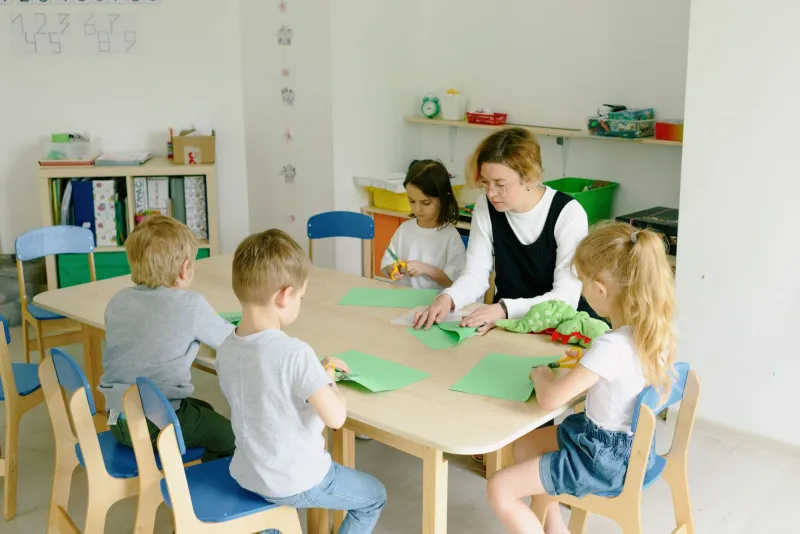
Walk into Melissa Tran's fifth-grade classroom in Austin, Texas on a Wednesday afternoon and the first thing you notice isn't a screen. It's the sound — the soft tearing of tissue paper, the crisp snap of a bone folder pressing a crease into cardstock, the quiet focus of twenty-two kids doing something with their hands that clearly has their full attention.
"I started noticing that when I gave kids devices, I got compliance," Tran says, smoothing a sheet of handmade mulberry paper across her desk. "When I gave them paper and told them to make something, I got engagement. There's a difference."
Tran is part of a growing wave of educators — art teachers, classroom generalists, occupational therapists, and school counselors — who are deliberately reintroducing tactile, paper-based making into their curricula. Not as nostalgia. Not as a break from the "real" learning. But as a core pedagogical tool that, they argue, does things for developing brains that digital interfaces simply cannot.
What Happens When Kids Actually Touch Their Materials
Child development researchers have been talking about the importance of tactile learning for decades, but the conversation has taken on new urgency as screen time in schools has accelerated. Dr. Renata Fields, an occupational therapist who consults with school districts in the Pacific Northwest, works with kids ranging from kindergarteners to middle schoolers on fine motor development.
"There's a generation of kids who can swipe and tap with incredible precision," she says, "but who struggle with tasks that require sustained grip, applied pressure, or the kind of hand-eye coordination you build by physically manipulating materials. Paper is actually a fantastic therapeutic tool because it gives constant feedback. You press too hard, it tears. You fold wrong, the crease shows. The material itself teaches."
That feedback loop is something educators keep coming back to. Paper doesn't have an undo button. A smudge is a smudge. A tear is a tear. And for kids growing up in environments where every mistake is one swipe away from erasure, that kind of material honesty turns out to be genuinely instructive.
Not Just Any Paper — The Specific Materials Matter
One of the more interesting developments in this classroom paper renaissance is how intentional teachers are getting about which papers they use and why. This isn't about construction paper from a big-box store. Teachers and therapists are sourcing materials thoughtfully, and the differences between paper types are doing specific work.
Japanese washi, with its long fibers and semi-translucent quality, shows up in several classrooms as a material for layering and light-table work. Its strength despite its delicacy — it tears with the grain but resists random ripping — teaches kids something intuitive about structure and direction. "Kids are genuinely surprised by washi," says Marco Delgado, an art teacher at a public school in Chicago. "It looks fragile. Then they try to tear it against the grain and it holds. That surprise is a learning moment."
Kraft paper, rough-textured and utilitarian, gets used differently — for big, gestural work where kids need to move their whole arm, not just their fingers. Its resistance and tooth respond to charcoal and oil pastel in ways that smooth surfaces don't, giving young artists real physical feedback about mark-making pressure.
Handmade papers with embedded botanicals or visible fiber variations are showing up in sensory-focused classrooms and therapeutic settings. The visual and textural irregularity of these sheets gives kids with attention challenges something to anchor to — a surface that rewards close looking and slow touching in a way that a uniform digital screen does not.
Focus, Confidence, and the Slow-Making Effect
Art therapist Jenna Okafor works with students in a suburban New Jersey school district, many of whom carry diagnoses of ADHD or anxiety. She's been integrating specialty papers into her sessions for the past three years and has tracked some patterns she finds compelling.
"There's something I call the slow-making effect," she explains. "When a kid sits down with a piece of handmade paper and a set of watercolors, the process has a natural pace. The paper absorbs at a certain rate. You can't rush it. Kids who struggle to slow down have to slow down, and after a few minutes, something shifts. I see it over and over."
Creative confidence is another theme that keeps surfacing. Several teachers described watching students who were disengaged or self-deprecating in digital art contexts come alive when working with physical paper. Part of it, they speculate, is that physical work looks and feels different from professionally polished digital output — there's no comparison to a slick app template when you're holding something you made with your hands from a blank sheet.
"When a kid holds up a collage they made from torn washi and says 'I made this,' there's ownership there that I don't see when they show me something they made on an iPad," says Delgado. "The paper is theirs in a way that a file isn't."
The Supply Reality — and the Creative Workaround
It would be dishonest not to acknowledge the budget piece. Specialty papers cost more than standard classroom supplies, and school art budgets in the US are notoriously underfunded. Teachers in this space have gotten resourceful — applying for small grants, partnering with local art supply stores, running classroom crowdfunding campaigns, and building relationships with paper suppliers who sometimes donate short runs or sample packs.
Some are also teaching resourcefulness as part of the curriculum itself. Scrap paper, misprints, and off-cuts become collage fodder. Students learn to work with what they have, which turns out to be its own valuable lesson about creative constraint.
A few districts have started pooling resources across schools — a shared specialty paper library of sorts, where teachers can check out materials for specific projects. It's a patchwork solution, but it's working.
What This Looks Like Going Forward
None of the educators or therapists interviewed here are arguing that technology should disappear from classrooms. That's not the point. The point is balance — and a recognition that certain kinds of learning require a certain kind of material.
Paper teaches patience. It teaches cause and effect. It teaches that the physical world has rules and textures and resistances that are worth understanding. For kids who are growing up more digitally fluent than any previous generation, those lessons might be more important now than they've ever been.
Back in Austin, Melissa Tran holds up a small accordion-folded book one of her students made from a sheet of hand-dyed lokta paper. The colors bleed into each other at the folds. The cover has a small tear that the kid turned into a mountain shape with a brown marker.
"She didn't ask me how to fix it," Tran says. "She just figured it out. That's what I want for them. The paper kind of taught her."
And honestly? That's a lesson worth folding into any curriculum.