When the Right Paper Changes Everything: Artists on the Moment Their Work Finally Clicked
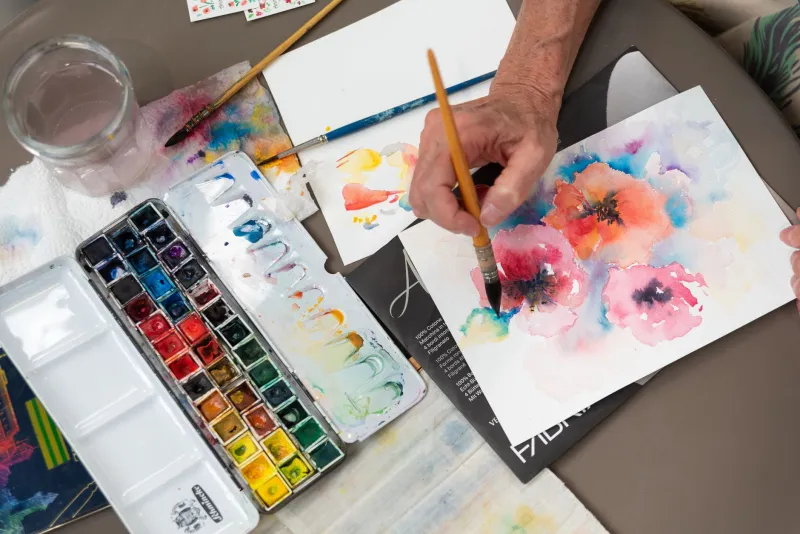
Ask any working artist about their early creative struggles, and somewhere in the answer you'll almost always find paper. Not technique. Not subject matter. Not even confidence in their own talent. Paper.
It sounds almost too simple to take seriously. But the more you dig into how creative people talk about their work — the breakthroughs, the plateaus, the moments things finally clicked — the more a pattern emerges. For a surprising number of artists and crafters, the pivot point wasn't a new teacher or a new medium. It was a different sheet of paper.
"I Thought I Just Wasn't Good Enough"
Sarah Mendez, a watercolorist based in Austin, Texas, spent two years convinced she had a fundamental skill problem. Her washes were blooming in the wrong places, her edges were ragged when she wanted them soft, and her colors dried dull and lifeless. She watched tutorials, took workshops, and practiced obsessively. Nothing changed.
"I was using whatever watercolor paper came in the big student pack from the craft store," she says. "It was technically labeled as watercolor paper, so I figured paper was paper."
A friend eventually handed her a single sheet of 140 lb cold-press cotton rag paper from a small specialty mill. She painted on it that same afternoon.
"I literally put my brush down and cried a little," she admits. "The paper was doing things I'd been trying to force for two years. The washes moved the way I wanted. The pigment stayed luminous. I wasn't bad at watercolor — I was fighting the wrong surface the whole time."
That experience, which artists and crafters describe in strikingly similar terms, isn't just an emotional anecdote. It points to something real about how materials shape creative confidence.
The Confidence Loop Nobody Talks About
Here's what's actually happening, psychologically speaking. When you're working on a surface that resists your intentions — paper that buckles, bleeds unpredictably, or deadens your medium — your brain interprets the results as personal failure. You adjust your technique. You second-guess your instincts. Over time, you develop workarounds that constrain rather than expand your creative range.
Switch to a material that responds the way you expect, and the loop reverses. Successes feel earned. Experiments feel worth attempting. The creative risk-reward calculation shifts in your favor.
Jamison Cole, a printmaker in Portland, Oregon, puts it bluntly: "Bad paper teaches you to make smaller choices. You stop trying things because you already know they won't work. Good paper makes you ambitious again."
Jamison spent years making reduction linocuts on whatever smooth white paper he could source affordably. His prints were technically clean but, as he describes it, "safe to the point of being boring." When he started working with Japanese kozo papers — lightweight, fibrous, with a texture that catches ink in unexpected and beautiful ways — his entire aesthetic shifted.
"The paper had its own personality," he says. "I stopped trying to control every variable and started collaborating with the material. My work got weirder and more interesting almost immediately."
It's Not About Spending More — It's About Choosing Better
One of the biggest misconceptions about specialty papers is that upgrading your materials means dramatically inflating your supply budget. For some papers, that's simply not true. And for those that do cost more per sheet, the math often works out differently than people expect.
Maya Thornton, a mixed-media artist in Chicago, makes that case directly. "When I was using cheap multipurpose paper, I'd go through a ton of it because nothing was working. I was frustrated, so I'd start over constantly. When I switched to a proper mixed-media paper with the right sizing and tooth, I actually used fewer sheets because I was making more intentional decisions. My supply costs didn't really go up."
There's also the question of what your time is worth. If an artist spends three hours fighting a surface that's actively undermining their technique, that's not a savings — that's a loss.
Tactile Quality and the Sensory Side of Creativity
Something the art school curriculum doesn't always cover: the physical experience of making art matters. A lot.
The weight of a sheet, the way it responds to touch before a single mark is made, the slight resistance or give under a pencil or brush — these sensory details are part of the creative experience in ways that are hard to quantify but easy to feel.
Lila Park, a calligrapher and paper artist based in Seattle, describes picking up a sheet of handmade lokta paper for the first time as a turning point in how she thought about her own craft. "It had this incredible texture and warmth. Just holding it made me want to make something worthy of it. That sounds a little dramatic, but it's true — the paper raised my standards for myself."
That dynamic — where the quality of your material sets an aspirational bar for the work itself — is something many specialty paper enthusiasts describe. There's a sense of respect for the material that translates into more careful, more intentional creative choices.
Finding Your Paper, Finding Your Voice
Not every artist's breakthrough looks the same, because not every artist needs the same thing from their paper. A printmaker's ideal surface is completely different from a bookbinder's or a watercolorist's or a collage artist's. The common thread isn't a specific product — it's the experience of finding a material that genuinely supports what you're trying to do.
For some creators, that discovery happens by accident, the way Sarah stumbled into cotton rag paper through a generous friend. For others, it's a deliberate process of sampling and testing until something locks in.
What almost everyone agrees on, though, is that the search is worth it. And that once you've worked on a surface that truly fits your practice, going back to commodity stock feels like a step backward you're not willing to take.
Jamison says it best: "Your paper isn't just a surface. It's half the conversation between you and your work. You want that conversation to go somewhere interesting."
The Takeaway
If you've been blaming your skills when your work isn't landing the way you want it to, it might be worth asking a different question first. Not what am I doing wrong — but what is my paper doing to me?
The shift from commodity to specialty materials isn't about status or spending. It's about removing friction between your intentions and your results. And for a lot of artists, that single change turned out to be the one that finally made everything else make sense.